
Theodicy, smishmodicy
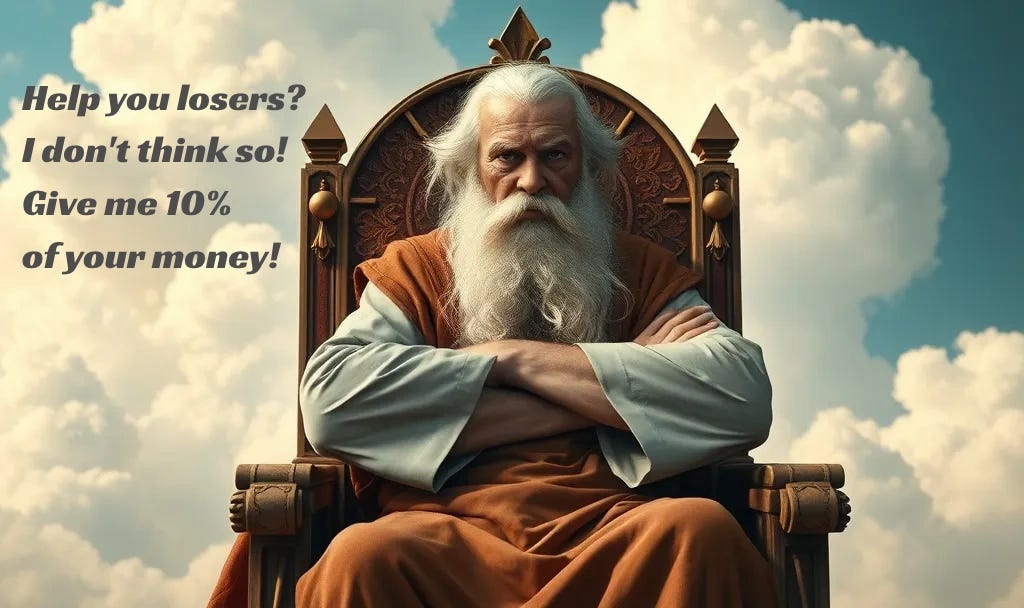
Why God allows evil and suffering is supposed to be this huge eternal mystery. Pffft. Hardly.

Ugh. I swore I wouldn’t start writing theology again. (See my books Penguins, Pain and the Whole Shebang [chosen by the publishing arm of the Episcopal Church to relaunch its legendary imprint, Seabury Books, which in its heyday published C.S. Lewis’s A Grief Observed and the first books written by the lion of Christian progressive theology, John Shelby Spong, who once likened me to Jesus but whatever]; I’m OK—You’re Not [which, upon its publication by NAV Press, caused such an uproar by conservative evangelicals declaring it heretical that NAV wiped the book off its website, yanked it off bookshelves across the country, and was planning to burn in a dumpster every copy of it in their warehouse [I’m not kidding]—except then the book started to sell [awkwarrrd!], and soon became the catalyst of this massively pervasive movement within Christianity born of it central theme that Christians should try actually listening to non-Christians instead of just trying to convert them all the freaking time); UNFAIR: Christians and the LGBT Question (self-published, and based largely on the theological writings I did during the five years I was the most read writer in America; and Being Christian, which Bethany House paid me $200,000 to write).
And now here am, after all these years, once again waxing theological.
Cool! Let’s do it.
So: if you are, stop being angry at God because He (or She, or They, or I could give an angel’s fart since of course God doesn’t have a gender; from now on the pronoun I’ll use for God is . . . ummm . . . Shey) does not prevent evil from happening in the world.
And before we go any further, please set aside the hoary ancient trope that what’s known as the theodicy—the reconciling of God in heaven with evil and suffering on earth—is an eternal mystery that no one can ever understand.
Please. SpongeBob SquarePants could understand this:
God wanted to create something as close to the totality of himself as shey could. So he created the human race.
God is (to say the least) fully independent. So of course shey wanted humans to also be that way.
And that is why God created people with two things: free will, and no way to ever know for sure that shey was real and actually existed—that inviolate, perpetual and particular ignorance being essential to the existence of humans’ free will.
Because, think about it. If you knew—with empirical, provable, objectively unarguable certainty—that an all-knowing and all-powerful Supreme Creator of the Universe fully existed and was completely cognizant of everything you ever did, said, or thought, you’d have the freewill of a houseplant.
If you can’t quite grasp how deeply true that is, then I don’t know what to tell you beyond that you haven’t thought about it hard enough, and/or that your imagination has failed you.
The fact that we cannot have both free will and the certainly of God constrains God from ever interfering with any person who is robbing another person of their free will, which is the very definition of inhumane treatment.
That’s why we put wrongdoers in prison: we take their free will because they took the free will of another.
But here’s the thing: it’s precisely because we all have free will that God is not necessary for the cessation of human suffering.
Stopping human suffering is our job, not God’s.
You cannot think of a single example of human suffering that wasn’t caused by, or that couldn’t be alleviated by, humans. (I’ll address “natural” evil—things like disease and natural disasters that cause suffering—a little further down.)
It is always up to the person who is doing the wrong to stop doing it, or to the people around that person to prevent them from doing it.
People are free to prevent others from doing wrong, but God is not.
And shey were, what would that even look like?
If you tried to grab something that wasn’t yours, would your arm freeze mid-air?
If you thought about taking something that wasn’t yours, would your brain just go blank? And how long would that last?
If you started gossiping about someone, would your jaw suddenly lock on you?
You get the point. It’s just . . . dumb, basically, to want God to somehow continuously and hyper-selectively violate the free will of anyone at all. That’s why shey doesn’t ever do it.
Well, God won’t interfere with anyone’s free will again, anyway—or at least not in the forseeable future.
The story of Christianity has it that the last time God decided to full-on interfere with human free will he did so by manifesting sheyself on earth as the literally divine person known to history as Jesus Christ.
And why would God have decided, one last time, to really seriously interfere with human free will?
Here’s why. You use your free will to make a million decisions a day. That, combined with the fact that you are a fully independent person who is instinctively driven to (in a word) survive, means that some of the decisions you make are necessarily going to be selfish or greedy or mean-spirited: to some degree or another, they are going to be harmful to someone, even if that someone is you.
And because you were born with free will and an innate sense of morality, that is going to cause you some measure of shame and/or guilt.
And here is the thing: shame and guilt are, by far, the most destructive forces in the human experience. They destroy everything that is good and precious about being a human.
And yet shame and guilt are a necessary and inevitable byproduct of free will.
And that, right there, is the problem with being human.
Which makes it a problem for God, who loves us.
And that is why God became Jesus who walked amongst us.
God manifested sheyself as Jesus for the very purpose of finally and indelibly doing at least five things for us humans:
Proving that Jesus really was God—see Jesus’ walking on water, healing the sick, bringing a dead guy back to life, and generally doing other things that mortal people really, really can’t—which was essential for convincingly . . .
Showing that God, through Jesus, loves all people always, and desires that we do the same.
Showing that God, through Jesus, has experienced true human suffering and pain, so that we never have to wonder is shey really “gets” us.
Giving people a way to be absolved of their shame and guilt whenever they need that forgiveness.
Gifting people with the Holy Spirit, which, in Jesus’ words, is “the Spirit of Truth, sent by God in my name, to live within you.”
And there we have it. That, right there, is everything that Christianity is (or should be, for sure).
Also, it’s a crucially great idea not to forget that from God’s perspective the human life lasts .0000000001% of a mini-micro nanoblink. What actually happens after any of us die is of course (and despite what anyone in a pulpit says about it) anyone’s guess. I can only share that I personally am not, by a very long shot, inclined to deny myself the genuine comfort that comes from believing in an afterlife, where I will be able to once again embrace loved ones I have lost on this side of the veil.
Finally, we come to the terrible phenomenon of suffering caused by sickness or disease, or by natural disasters: floods, hurricanes, earthquakes, fires.
Why, goes up the cry, does God not prevent the suffering of innocents victimized by these kinds of “natural” evils?
And this might, for sure, be a majorly legitimate question. The problem is that we don’t know if it is or not.
And why don’t we know that?
Because we have no idea of the extent to which we humans might, all by ourselves, be capable of preventing or mitigating the suffering caused by sicknesses and natural disasters.
And why don’t we know that?
Because we have never really cared enough to find out.
Until the whole human race, as one, decides to dedicate all of the resources that it spends on war and destruction to figuring out how nobody could ever again die from a disease or a hurricane or a flood or an earthquake or a fire, we have no idea what might be possible in that regard.
We can’t complain that God isn’t solving for us problems that we don’t even care enough about to try solving for ourselves.
It’s folly to stretch up our hands to God before we’ve held them out to everyone around us.
Another way of putting all of this: A girl was born in Sudan who would have grown up to cure cancer, if only she hadn’t fucking starved to death.
John, you always leave behind something to think about further. I’ve been searching all my life and will continue to do so. One never knows when lightening will strike just the right chord.
Loved this John! As always. And as always I have questions:
1) Please please please tell us about Bishop Spong likening you to Jesus!
2) I was with you up until the natural disaster part, where I immediately started thinking about the 1755 earthquake and tsunami in Lisbon. I’m not sure how that fits with what you said about God and natural disasters.
I love “shey”! ❤️